Some text here:
Turtles are reptiles of the order Chelonii[2] or Testudines characterised by a special bony or cartilaginous shell developed from their ribs and acting as a shield.[3] Turtle may refer to the chelonian order as a whole (American English) or to fresh-water and sea-dwelling chelonians (British English).[4]
The order Chelonii or Testudines includes both extant (living) and extinct species. The earliest known turtles date from 220 million years ago,[5] making turtles one of the oldest reptile groups and a more ancient group than lizards, snakes orcrocodiles. Of the many species alive today, some are highly endangered.[6]
Like all other extant reptiles, turtles are ectotherms—their internal temperature varies according to the ambient environment, commonly called cold-blooded. However, because of their high metabolic rate, leatherback sea turtles have a body temperature that is noticeably higher than that of the surrounding water.
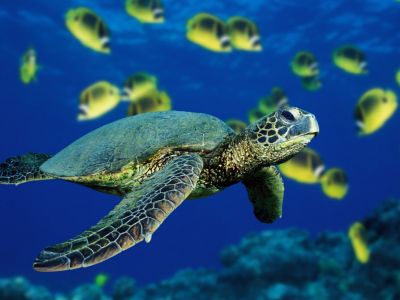
Turtles are classified as amniotes, along with reptiles, dinosaurs (including birds), and mammals. Like other amniotes, turtles breathe air and do not lay eggs underwater, although many species live in or around water.

The meaning of the word turtle differs from region to region. In North America, all chelonians are commonly called turtles, including terrapins and tortoises.[9][10] In Great Britain, the word turtle is used for sea-dwelling species, but not for tortoises.
The term tortoise usually refers to any land-dwelling, non-swimming chelonian.[10] Most land-dwelling chelonians are in the Testudinidae family, only one of the 14 extant turtle families.[11]
Terrapin is used to describe several species of small, edible, hard-shell turtles, typically those found in brackish waters and is an Algonquian word for turtle.[9]

No comments:
Post a Comment